

How To Play Super Mario All Stars
| Super Mario All-Stars | |
|---|---|
 | |
| Developer(due south) | Nintendo EAD |
| Publisher(s) | Nintendo |
| Manager(due south) | Takashi Tezuka |
| Producer(s) | Shigeru Miyamoto |
| Programmer(due south) | Toshihiko Nakago |
| Artist(s) |
|
| Composer(s) |
|
| Series | Super Mario |
| Platform(s) | Super NES, Wii |
| Release | Super NES
|
| Genre(s) | Platform |
| Mode(southward) | Single-role player, multiplayer |
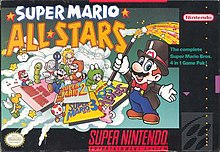
Super Mario All-Stars [a] is a 1993 compilation of platform games for the Super Nintendo Entertainment System (SNES). Information technology contains remakes of Nintendo'due south four Super Mario games released for the Nintendo Entertainment System (NES) and the Famicom Disk Organisation: Super Mario Bros. (1985), Super Mario Bros.: The Lost Levels (1986), Super Mario Bros. 2 (1988), and Super Mario Bros. 3 (1988). Equally in the original games, players command the Italian plumber Mario and his brother Luigi through themed worlds, collecting power-ups, avoiding obstacles, and finding secrets. The remakes feature updated graphics—including the addition of parallax scrolling—and music, modified game physics, and bug fixes.
Nintendo Amusement Analysis & Development developed the compilation after the completion of Super Mario Kart (1992) at the suggestion of Mario creator Shigeru Miyamoto. No longer restricted by the limitations of the 8-scrap NES, Nintendo chose to remake them for the 16-bit SNES. The developers based the updated designs on those from Super Mario World (1990) and strove to retain the feel of the original games. Nintendo released Super Mario All-Stars worldwide in tardily 1993 and rereleased it in 1994 with Super Mario World included. The compilation marked The Lost Levels ' offset release exterior Nippon; it was not released on the NES in Western territories considering Nintendo accounted it as well hard at the time.
Super Mario All-Stars received acclaim and is one of the bestselling Super Mario games, with ten.55 one thousand thousand copies sold by 2015. Critics considered it one of the all-time SNES games and praised the updated graphics and music, but criticized its lack of innovation. All-Stars served as a basis for later Super Mario rereleases and was described by Famitsu as a function model for video game remakes. It was rereleased twice for the ceremony of Super Mario Bros.: in 2010 (the 25th anniversary) in a special package for the Wii, and in 2020 (the 35th anniversary) for the Nintendo Switch. The Wii rerelease sold 2.24 1000000 copies past 2011 but received mixed reviews, with criticism for the lack of additional games or features.
Content [edit]
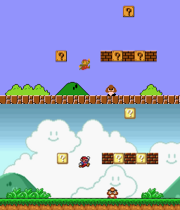
Comparison of the NES version (top) and the Super Mario All-Stars version (bottom) of Super Mario Bros. Note the more detailed environment and groundwork of the latter.
Super Mario All-Stars is a compilation of four video games in the Super Mario series—Super Mario Bros. (1985), Super Mario Bros.: The Lost Levels (1986), Super Mario Bros. two (1988),[b] and Super Mario Bros. 3 (1988)[three]—originally released for the 8-bit Nintendo Entertainment System (NES) and the Family Figurer Deejay Organisation.[iv] Additionally, a ii-thespian bonus game based on Mario Bros. (1983) can be accessed from Super Mario Bros.3.[v] The games are faithful remakes featuring the original premises and level designs intact.[6] [7] They are 2D side-scrolling platformers where the role player controls the Italian plumber Mario and his brother Luigi through themed worlds. They spring betwixt platforms, avert enemies and inanimate obstacles, find subconscious secrets (such as warp zones and vertical vines), and collect power-ups like the mushroom and the Invincibility Star.[4] [viii]
Super Mario Bros., The Lost Levels, and Super Mario Bros.3 follow Mario and Luigi equally they effort to rescue Princess Toadstool from the villainous Bowser, with the player stomping on enemies and breaking bricks every bit they progress. Super Mario Bros.two features a different storyline and gameplay style: Mario, Luigi, the Princess, and Toad must defeat the evil King Wart, who has cursed the land of dreaming. In this game, the player picks upwardly and throws objects such equally vegetables at enemies.[iv] [9] The thespian selects one of the four from an in-game menu and can exit at whatever fourth dimension by pausing.[ten]
The games in Super Mario All-Stars are updated to accept advantage of the sixteen-bit hardware of the Super Nintendo Entertainment System (SNES). The updates range from remastered soundtracks to revamped graphics and the addition of parallax scrolling.[6] Game physics are slightly modified and some glitches, such as the Minus Earth in Super Mario Bros., are fixed.[11] [12] The difficulty level of The Lost Levels is toned down slightly: poison mushroom hazards, which tin can kill the player, are easier to distinguish,[13] and there are more i-ups and checkpoints.[fourteen] All-Stars includes the selection to salve player progress, which the original games lack.[15] Players can resume the games from the starting time of any previously accessed world, or in The Lost Levels, any previously accessed level.[x] Up to four individual relieve files tin can be stored for each game.[12]
Development [edit]

Super Mario All-Stars was developed by Nintendo Entertainment Analysis & Development,[16] a former game development division of Japanese publisher Nintendo.[17] It had the working title Mario Extravaganza equally, co-ordinate to Nintendo president Satoru Iwata, "It was a single game cartridge packed full of the starting time ten years of Nintendo's rich history."[18]
The concept emerged after the completion of Super Mario Kart (1992).[19] The side by side major Mario game, Yoshi's Island (1995), was all the same in production, creating a gap in Nintendo's release schedule.[xx] Mario creator Shigeru Miyamoto[21] suggested developing a "value pack" containing all the Super Mario games. Co-ordinate to assistant manager and designer Tadashi Sugiyama, Miyamoto's idea was to give players a run a risk to feel The Lost Levels.[19] Nintendo had deemed The Lost Levels, released in Nippon every bit Super Mario Bros.ii in 1986, too hard for the N American market and instead released a retrofitted version of the game Doki Doki Panic (1987).[22] [23] Equally such, it had non attracted a large audience.[nineteen] Rather than simply transfer the NES games to a SNES cartridge, Nintendo remade them for SNES.[20]
One of the first tasks the developers accomplished was updating and reworking the graphics for the SNES.[xix] The more than powerful hardware gave the developers more colors to utilize in Mario's globe.[24] Designer Naoki Mori recalled feeling intimidated, as it was merely his third twelvemonth at Nintendo and he had been tasked with updating its flagship series.[19] The artists based their designs on those from the SNES game Super Mario World (1990) and added a black outline around Mario to make him stand out against the backgrounds.[19] [24] For blackness backgrounds like those in castles and bonus areas in Super Mario Bros., Mori and Sugiyama added details such as portraits of Bowser and Mario. The team strove to retain the feel of the original games by leaving level designs and Mario'south movement unaltered. To preserve the gameplay, they added no new animations or actions.[24]
Alterations were made past hand, and Sugiyama ran the original Super Mario Bros. while he worked on the remake and so he could compare them next.[24] Staff who worked on the original games were involved and consulted during development.[19] The team preserved glitches they deemed helpful, such as a manner to generate space lives in Super Mario Bros.; notwithstanding, for that glitch, they limited how many lives the histrion could earn. Sugiyama recalled the team fixed glitches they thought would hinder players' progress, although this created some differences in the controls. To make the games easier, the team increased the number of lives they start with. They too added a salve-game option, a feature made possible past the contempo development of battery fill-in cartridges. Save points were added after each level in The Lost Levels to reduce its difficulty. While Mori helped with the other remakes, he avoided debugging The Lost Levels because it was so hard.[11]
Release [edit]
Nintendo released Super Mario All-Stars in Japan on July xiv, 1993, in Due north America on August 11, 1993, and in Europe on Dec 16, 1993.[16] In Nippon, it was released equally Super Mario Drove.[xviii] The compilation marked the first time The Lost Levels was released outside Japan.[three] Between September and October 1993, Nintendo Power held a contest in which players who reached a specific surface area in The Lost Levels would receive a Mario atomic number 26-on patch.[25] The compilation became the SNES's pack-in game[3] and sold x.55 million copies by 2015,[26] including 2.12 million in Japan,[27] making it i of the bestselling Super Mario games.[26] In the United Kingdom, it was the top-selling video game in September 1993.[28]
Nintendo rereleased Super Mario All-Stars in December 1994 as Super Mario All-Stars + Super Mario World,[29] which adds Super Mario Globe.[3] Super Mario World is largely identical to the original,[6] but Luigi's sprites were updated to brand him a distinct character and not just a palette swap of Mario.[3] A version of Super Mario Collection was also released on Nintendo's Satellaview, a Japan-sectional SNES add-on allowing users to receive games via satellite radio.[30]
In 2010, for the 25th anniversary of Super Mario Bros., [31] Nintendo released Super Mario All-Stars 25th Anniversary Edition (Super Mario Collection Special Pack in Japan) for the Wii in Nippon on October 21, in Europe on December 3, and in Due north America on December 12.[32] The 25th Anniversary Edition comes in special packaging containing the original Super Mario All-Stars ROM image on a Wii disc, a 32-page Super Mario History booklet containing concept art and interviews, and a soundtrack CD containing audio effects and 10 tracks from nigh Mario games up to Super Mario Galaxy ii (2010).[31] [32] [33] This version sold 2.24 million copies—920,000 in Japan and 1.32 million overseas—by March 2011.[34] The compilation was over again rereleased in 2020 on the Nintendo Switch for the original game's 35th anniversary, coming equally part of the subscription-based Nintendo Switch Online's classic games service.[35]
Reception [edit]
The compilation received disquisitional acclaim.[three] Reviewers thought information technology was a must-have that represented the SNES library at its finest,[7] [37] and would occupy players for hours, if non days.[12] [41] Nintendo Magazine System (NMS) estimated information technology could entertain players for up to a year.[41] A critic from Computer and Video Games (CVG) described Super Mario All-Stars as the Super Mario director's cut, bringing fans updated graphics and audio in addition to a game (The Lost Levels) few had experienced.[44] A reviewer from Electronic Gaming Monthly (EGM), overwhelmed by the improvements, called information technology a "masterpiece from first to end".[7]
Critics praised the collection's games as excellent remakes, stating they aged well and appreciating the effort that went into retrofitting them for the SNES.[15] [45] [46] For AllGame, retrospectively reviewing the version including Super Mario Globe, the compilation represented "the accented elevation of the 2D platform genre".[6] Critics said the games played just equally they did on the NES and retained what made them cracking.[15] [39] [46] EGM 's reviewers were satisfied the various secrets were left intact.[seven] Nintendo Power wrote the games got better with time,[xv] while EGM and CVG suggested players carelessness the antiquated NES games for the SNES upgrade.[vii] [44] Although ane of the NMS reviewers admitted to preferring Super Mario Globe, citing the compilation'southward less instinctive controls and somewhat simplistic graphics, he said Super Mario All-Stars was nonetheless worth buying.[47]
Reviewers liked the updates the games received in the transition to the SNES.[7] [15] [46] Nintendo Power, for case, praised the addition of a relieve feature, assertive it would give players who never finished the games a take a chance to practise so.[15] The updated graphics were praised;[six] [12] [48] NMS 's reviewers admired the attending to detail, which they said made the compilation worth buying,[48] and AllGame called the visuals colorful and cartoonish.[half-dozen] CVG idea the backgrounds could have benefited from more detail,[37] only GamePro thought they were detailed enough.[12] Reviewers offered praise for the updated soundtracks every bit well.[vi] [7] [12] For EGM, the sound enhanced the experience,[7] and GamePro noted the addition of echo and bass effects.[12] In a 2005 retrospective, Famitsu called All-Stars a role model for future video game remakes.[39]
Criticism of Super Mario All-Stars by and large focused on its lack of innovation.[7] [15] [38] Bated from the 16-scrap updates, relieve feature, and (for American audiences) The Lost Levels, Nintendo Ability wrote, the compilation did non nowadays annihilation new,[15] a sentiment CVG echoed.[37] "[I]f the best cart effectually is a compilation of old eight-bit games," wrote Edge, "it doesn't say much for the standard of new games, does it?"[38] Reviewers also disagreed over which game in the compilation was best. One EGM reviewer argued Super Mario Bros.2 was,[seven] merely another critic and Nintendo Power said that laurels went to The Lost Levels.[7] [49] NMS, CVG, and Edge, withal, criticized The Lost Levels for its difficulty,[37] [38] [48] with Nintendo Magazine System viewing it as just an interesting bonus.[48] Edge said the compilation was worth ownership for Super Mario Bros. and Super Mario Bros.3, but not Super Mario Bros.2 considering the reviewer found its gameplay lacking fluidity and the level design poor.[38]
25th Anniversary Edition [edit]
According to the review aggregate website Metacritic, Super Mario All-Stars 25th Anniversary Edition received "mixed or average reviews".[l] Critics were disappointed by the unaltered rerelease, which they establish lazy. They expressed surprise the developers did not take advantage of the extra infinite Wii discs offer to add more than games or use the Super Mario All-Stars + Super Mario World version.[33] [51] [52] [53] [56] The Guardian compared the 25th Anniversary Edition unfavorably to the Wii remake of the Nintendo 64 game GoldenEye 007 (1997) released earlier that year. The writer argued that though GoldenEye offered new graphics, levels, and reasons to play, Super Mario All-Stars was but the aforementioned compilation released on the SNES in 1993.[56] The A.V. Gild went equally far every bit to land the 25th Anniversary Edition "fails on every conceivable level, and a few inconceivable ones, as well".[57]
The Super Mario History booklet divided reviewers. Nintendo Life and The A.V. Club panned it for what they considered cheap production quality.[33] [57] Although Nintendo Life constitute information technology somewhat intriguing,[33] both called the one-judgement programmer comments vague and meaningless.[33] [57] The A.V. Club said the level design documents were "obscured by pictures, and schematics written in Japanese with no translation".[57] Meanwhile, IGN opined the booklet failed to demonstrate Mario's importance, missing data almost the Game Boy installments, Yoshi'due south Isle, and other Nintendo games.[53] Others found the booklet interesting;[52] [54] [56] GamesRadar+ stated that for Mario fans Miyamoto's original outline "alone is worth $xxx".[52]
The soundtrack CD received criticism and was viewed equally a missed opportunity.[33] [53] [57] Reviewers were disappointed information technology independent only ten tracks and that half of it was dedicated to sound furnishings.[33] [53] [57] For case, Nintendo Life said it "doesn't fifty-fifty make full one-half of that potential running time" of 74 minutes of CD audio.[33] Similarly, IGN said x tracks were non enough, including only one of the xx tracks from Super Mario Galaxy (2007).[53] Conversely, The Guardian said the CD would make players happy and GamesRadar+ idea it was rare for Nintendo to release game soundtracks outside Japan.[52] [56] GamesRadar+ said the CD helped make the compilation seem of import, noting that it contained the get-go official release of the Super Mario Bros. "Ground Theme".[52]
Nintendo Life wrote there was no reason for Nintendo not to add more than to the compilation, suggesting information technology would non accept taken much effort to add interviews, advertisements, and other behind-the-scenes content.[33] Despite the full general disappointment, critics said the games remained high quality.[33] [51] [53] [56] [57] Some admitted to preferring the NES originals,[52] [57] only others idea the updated 16-bit graphics and addition of a save feature were bang-up.[33] [51] [54] [55] Withal, some encouraged readers to purchase the games individually on the Wii'southward Virtual Console service instead if they had not already purchased the compilation.[33] [57] GamesRadar+, IGN, and Official Nintendo Magazine noted this was a cheaper fashion to experience them.[52] [53] [55] As Nintendo World Report wrote, "in the stop, the value of [Super Mario All-Stars] lies in whether you want to invest once more in these classic Mario titles."[54]
Legacy [edit]
In 1997, when the EGM staff ranked Super Mario Bros., Super Mario Bros.2, and Super Mario Bros.3 in its list of the best console games of all fourth dimension, they specified the All-Stars edition for all three games. In the listing for Super Mario Bros.3 (ranked at number2), they noted, "Just a reminder: We're not including compilation games on our Top 100, or Super Mario All-Stars would be the clear-cut number-one game of all time."[58] Famitsu called All-Stars a role model for video game remakes in a 2005 retrospective.[39] In 2018, Complex named All-Stars the tenth-all-time SNES game.[59] In 1996, GamesMaster named All-Stars the 3rd superlative SNES game.[60]
Super Mario Advance (2001) and Super Mario Advance 4: Super Mario Bros. 3 (2003), remakes of Super Mario Bros.2 and 3 for Nintendo'southward Game Male child Accelerate, incorporate elements from the Super Mario All-Stars versions, such as the updated graphics and sound.[61] [62] [63] Super Mario 3D All-Stars, a Nintendo Switch compilation of the kickoff three 3D Super Mario games, was released for the series' 35th anniversary in 2020.[64] According to Eurogamer, Nintendo internally referred to the compilation as Super Mario All-Stars 2 during evolution.[65]
Notes [edit]
- ^ Known in Nihon as Super Mario Collection ( スーパーマリオコレクション )
- ^ In the Japanese version, The Lost Levels is referred to every bit Super Mario Bros.2, while Super Mario Bros.2 is called Super Mario USA.[2] See #Development and release for more than data.
- ^ EGM 'southward four reviewers gave three scores of 9/10 and one of x/10.[vii]
- ^ Famitsu gave two 8/10 scores, one perfect score, and one half-dozen/10 score.[39]
- ^ GamePro gave four five/v scores for graphics, sound, control, and fun cistron.[12]
- ^ Nintendo Power gave a 3.9/5 score for presentation, a 4.2/v score for gameplay, and two 4.ane/5 scores for claiming and theme/fun.[40]
- ^ Score based on 29 reviews.[50]
References [edit]
Citations [edit]
- ^ "業務実績" [Business Performance]. DJ Alice (in Japanese). January 3, 2007. Archived from the original on September 30, 2012.
- ^ Edge staff 1993, pp. 98–99.
- ^ a b c d due east f Dark-brown, Andrew (August xviii, 2011). "Super Mario All-Stars + World". Nintendo World Report. Archived from the original on February 6, 2017. Retrieved April 13, 2019.
- ^ a b c NMS staff 1993, pp. 20–25.
- ^ Edge staff 1993, p. 99.
- ^ a b c d e f k Huey, Christian. "Super Mario All-Stars + Super Mario Globe". AllGame. Archived from the original on February 16, 2010. Retrieved April 13, 2019.
- ^ a b c d e f g h i j k 50 g EGM staff 1993, p. 28.
- ^ M-Human 1993, pp. 98–100.
- ^ Nintendo of America 1993, pp. v–30.
- ^ a b Nintendo of America 1993, p. 3.
- ^ a b Iwata, Satoru (October 21, 2010). "Super Mario All-Stars : Likewise Difficult Even For a Developer". Iwata Asks. Nintendo. Archived from the original on July 25, 2015. Retrieved April 13, 2019.
- ^ a b c d eastward f g h G-Human being 1993, p. 98.
- ^ Whitehead, Dan (September 15, 2007). "Virtual Panel Roundup". Eurogamer. Archived from the original on September xvi, 2014. Retrieved April 1, 2015.
- ^ Provo, Frank (October 5, 2007). "Super Mario Bros.: The Lost Levels Review". GameSpot. Archived from the original on Baronial 24, 2015. Retrieved Baronial 24, 2015.
- ^ a b c d east f g h Nintendo Power staff 1993, p. 100.
- ^ a b "Super Mario All-Stars (SNES / Super Nintendo) News, Reviews, Trailer & Screenshots". Nintendo Life. Archived from the original on April 12, 2019. Retrieved Apr 12, 2019.
- ^ Kohler, Chris (September 14, 2015). "Nintendo Consolidates Its Game Development Teams". Wired. Archived from the original on September 15, 2015. Retrieved Apr 12, 2019.
- ^ a b Iwata, Satoru (Oct 21, 2010). "Super Mario All-Stars : The History of Super Mario in One Game". Iwata Asks. Nintendo. Archived from the original on July 25, 2015. Retrieved April 13, 2019.
- ^ a b c d e f grand Iwata, Satoru (Oct 21, 2010). "Super Mario All-Stars : Updating the Graphics". Iwata Asks. Nintendo. Archived from the original on July 25, 2015. Retrieved April 12, 2019.
- ^ a b Whitehead, Thomas (August xx, 2015). "Mario History: Super Mario All-Stars—1993". Nintendo Life. Archived from the original on April 12, 2019. Retrieved April 12, 2019.
- ^ McLaughlin, Rus (September 13, 2010). "IGN Presents: The History of Super Mario Bros". IGN. Archived from the original on Apr 12, 2019. Retrieved April 12, 2019.
- ^ Schreier, Jason (January 7, 2015). "30 Minutes of Impossibly Precise Mario Speedrunning". Kotaku. Archived from the original on April ii, 2015. Retrieved June xix, 2019.
- ^ Ashcraft, Brian (Oct 28, 2010). "Super Mario All-Stars Coming To America". Kotaku. Archived from the original on May 3, 2015. Retrieved June xix, 2019.
- ^ a b c d Iwata, Satoru (October 21, 2010). "Super Mario All-Stars : Of Course, the Fashion It Feels is Central". Iwata Asks. Nintendo. Archived from the original on July 25, 2015. Retrieved April 12, 2019.
- ^ Nintendo Power staff 1993, p. 22.
- ^ a b O Malley, James (September 11, 2015). "30 Best-selling Super Mario Games of All Fourth dimension on the Plumber's 30th Birthday". Gizmodo. Archived from the original on November 16, 2018. Retrieved April 22, 2019.
- ^ "Japan Platinum Game Chart". The Magic Box. Archived from the original on October 17, 2012. Retrieved April 18, 2019.
- ^ CVG 1993, p. 7.
- ^ "Super NES Games" (PDF). Nintendo. Archived from the original (PDF) on September 20, 2008. Retrieved July 31, 2018.
- ^ Bivens, Danny (October 27, 2011). "Satellaview". Nintendo World Written report. Archived from the original on January 27, 2016. Retrieved Apr 14, 2019.
- ^ a b Ashcraft, Brian (September 2, 2010). "Written report: Wii Getting Super Mario All-Stars". Kotaku. Archived from the original on April 14, 2019. Retrieved Apr 14, 2019.
- ^ a b "Super Mario All-Stars 25th Anniversary Edition (Wii) News, Reviews, Trailer & Screenshots". Nintendo Life. Feb 9, 2011. Archived from the original on October 8, 2018. Retrieved Apr xiv, 2019.
- ^ a b c d e f g h i j thousand l one thousand McFerran, Damien (December 21, 2010). "Super Mario All-Stars 25th Anniversary Edition Review (Wii)". Nintendo Life. Archived from the original on April 14, 2019. Retrieved April fourteen, 2019.
- ^ "Nintendo Co., Ltd. Financial Results Conference for Financial Year Concluded March 2011" (PDF). Nintendo. April 26, 2011. p. five. Archived (PDF) from the original on June 24, 2016. Retrieved April 22, 2019.
- ^ Doolan, Liam (September 3, 2020). "Super Mario All-Stars Is At present Available On Nintendo's Switch Online SNES Service". Nintendo Life. Archived from the original on September 3, 2020. Retrieved September three, 2020.
- ^ "Super Mario All-Stars for Super Nintendo". GameRankings. Archived from the original on December 9, 2019. Retrieved Jan 6, 2021.
- ^ a b c d e CVG staff 1993, p. 32.
- ^ a b c d e Edge staff 1993, p. 86.
- ^ a b c d east Famitsu staff 2005, p. 41.
- ^ a b Nintendo Power staff 1993, p. 105.
- ^ a b c NMS staff 1993, p. 25.
- ^ "The Super League". SNES Force. No. 8 (January 1994). December 23, 1993. p. 30.
- ^ "News". Nintendo Magazine System. No. 22. July 1994. pp. 10–1.
- ^ a b CVG staff 1993, p. 31.
- ^ CVG staff 1993, p. 30.
- ^ a b c NMS staff 1993, pp. 23–25.
- ^ NMS staff 1993, p. 23.
- ^ a b c d NMS staff 1993, p. 24.
- ^ Nintendo Power staff 1993, p. xvi.
- ^ a b c "Super Mario All-Stars: 25th Anniversary Edition for Wii Reviews". Metacritic. Archived from the original on February 19, 2018. Retrieved Apr 22, 2019.
- ^ a b c d Alan Mariott, Scott (December 17, 2010). "Super Mario All-Stars Review". G4. Archived from the original on Jan 26, 2011. Retrieved June 16, 2019.
- ^ a b c d east f g h Elston, Brett (Dec 11, 2010). "Super Mario All-Stars review". GamesRadar+. pp. 1–2. Archived from the original on April 22, 2019. Retrieved April 26, 2019.
- ^ a b c d eastward f 1000 h George, Richard (December ten, 2010). "Mario All-Stars Express Edition Review". IGN. Archived from the original on April 22, 2019. Retrieved Apr 26, 2019.
- ^ a b c d Hernandez, Pedro (Dec 17, 2010). "Super Mario All-Stars Review". Nintendo World Report. Archived from the original on Apr 22, 2019. Retrieved Apr 26, 2019.
- ^ a b c Scullion, Chris (December two, 2010). "Review: Super Mario All-Stars Wii". Official Nintendo Magazine. Archived from the original on Dec 5, 2010. Retrieved June 16, 2010.
- ^ a b c d due east f Howson, Greg (December 6, 2010). "Super Mario All-Stars 25th Anniversary—review". The Guardian. Archived from the original on April 22, 2019. Retrieved April 26, 2019.
- ^ a b c d e f k h i Heisler, Steve (Dec 27, 2010). "Super Mario All-Stars Limited Edition". The A.Five. Club. Archived from the original on April 22, 2019. Retrieved April 26, 2019.
- ^ EGM staff 1997, p. 156.
- ^ Knight, Rich (April xxx, 2018). "The Best Super Nintendo Games of All Time". Complex . Retrieved February 12, 2022.
- ^ "The GamesMaster SNES Tiptop ten" (PDF). GamesMaster (44): 75. July 1996.
- ^ "3.開発者インタビュー『スーパーマリオアドバンス』" (in Japanese). Nintendo. Retrieved July vii, 2019.
- ^ Harris, Craig (May 14, 2003). "E3 2003: Hands on: Super Mario Accelerate four". IGN. Archived from the original on April 13, 2019. Retrieved April 13, 2019.
- ^ Bee, Jonathan (January 27, 2016). "Super Mario Advance four: Super Mario Bros. 3 Review (Wii U eShop / GBA)". Nintendo Life. Archived from the original on April 13, 2019. Retrieved April thirteen, 2019.
- ^ McWhertor, Michael (September 3, 2020). "Nintendo bringing Super Mario 64, Sunshine, and Milky way to Switch". Polygon. Archived from the original on September 15, 2020. Retrieved September 3, 2020.
- ^ Phillips, Tom (March 31, 2020). "More details sally on Nintendo'due south Mario remasters". Eurogamer. Archived from the original on September 15, 2020. Retrieved March 31, 2020.
Bibliography [edit]
- "100 All-time Games of All Time". Electronic Gaming Monthly. No. 100. Ziff Davis. November 1997. p. 156.
- "Charts: All Formats Top 20". Reckoner and Video Games. No. 144. EMAP. October 15, 1993. p. seven.
- CVG staff (October 1993). "Super Mario All-Stars". Estimator and Video Games. No. 142. EMAP. pp. thirty–32.
- Border staff (Oct 1993). "Testscreen". Edge. No. 1. Time to come plc. pp. 81–107.
- Famitsu staff (June sixteen, 2005). "クロスレビュー優良ソフトパーフェクトカタログ 上巻」". Famitsu (in Japanese). Vol. 1. Enterbrain. p. 41.
- 1000-Man (Nov 1993). "Super NES ProReview: Super Mario All-Stars". GamePro. No. 52. International Data Group. pp. 98–100.
- Harris, Steve; Semrad, Ed; Alessi, Martin; Ten, Sushi (September 1993). "Review Crew". Electronic Gaming Monthly. Vol. half-dozen, no. 9. Sendai Publishing. pp. 22–36.
- Nintendo Mag Organization staff (August 1993). "Super Mario All-Stars". Nintendo Mag Arrangement. No. 11. EMAP. pp. 20–25.
- Nintendo Power staff (September 1993). "Super Mario All-Stars". Nintendo Power. No. 52. Nintendo of America. pp. xvi–23, 100–105.
- Super Mario All-Stars instruction transmission . Nintendo of America. 1993. pp. ane–38.
External links [edit]
- Official website
- Super Mario All-Stars at MobyGames


How To Play Super Mario All Stars,
Source: https://en.wikipedia.org/wiki/Super_Mario_All-Stars
Posted by: elzypalaing.blogspot.com
0 Response to "How To Play Super Mario All Stars"
Post a Comment